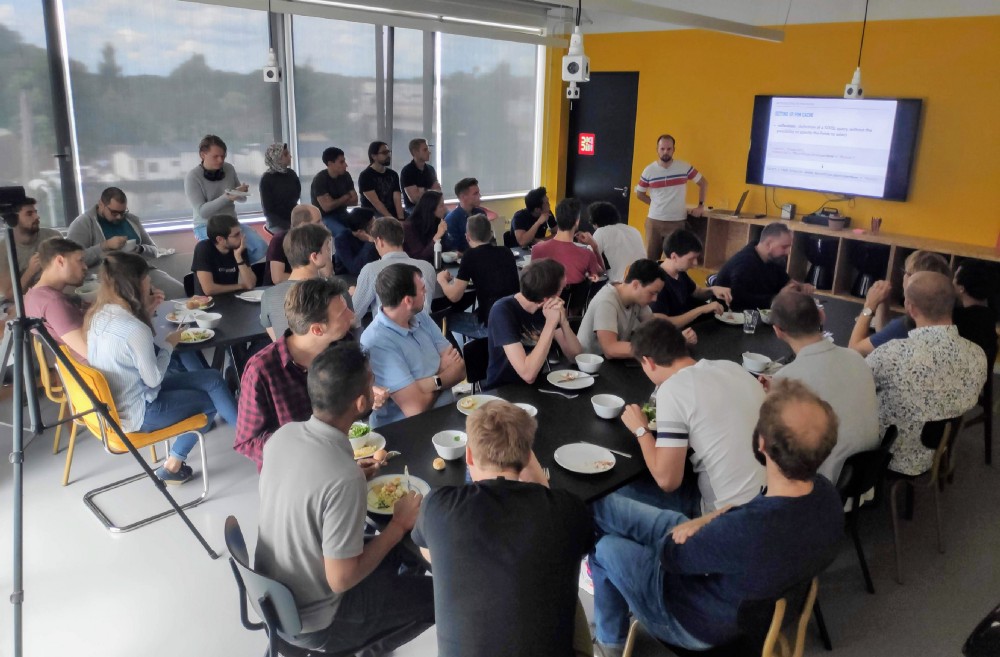
Gaining knowledge is an essential part of learning and growing. However, reading articles, books, and following the latest tech news can’t teach you everything. There’s a different type of knowledge that we can only learn from each other. This implicit knowledge includes insights, intuitions, and personal experiences and is shared mostly through informal socializing with colleagues.
As Picnic grew, it became more difficult to socialize with everyone.When I joined Picnic a little over a year ago the tech team consisted of 50 people. There were a few teams, and it was easy enough to know what others were up to. It was not uncommon to talk to most colleagues on a weekly basis, so knowledge would spread naturally. In contrast, today’s tech team counts close to 100 people; double the amount since last year. New colleagues are still joining every week, and remembering names can be a challenge, let alone actively learning from each other’s work.
Two new channels were introduced to facilitate knowledge-sharing. First is the TechStandup:a weekly presentation about team roadmaps and achievements. And the second channel are Guilds: these are interest groups centered around a specific topic (we currently have SQL, MongoDB, and Reactive Programming) that host discussions and presentations.
Unfortunately, not all topics neatly fit into these two channels. If something was too specific for the tech standup and not in the domain of an existing guild, then the only way to share it was one-on-one, even if the content was relevant for a wider audience. As a result, we were wasting opportunities to learn from each other simply because there was no adequate space to share. In the rest of this article, I’d like to introduce the Lunch & Learn initiative that emerged one year ago to create this space.
Lunch & Learn
The main goal of the Lunch & Learn was to create a space where anyone could talk about anything, as long as they thought it would be interesting for others. Hosting the sessions during lunch has the significant advantage that nobody needs to take time out of their day to be there. This lowers the bar for speakers as it relieves some of the pressure of delivering a perfectly polished presentation. It also makes it easier for attendees as everybody needs to eat lunch, regardless of how busy their schedule is.
Attendance has been stable throughout the different sessions. Some topics were more popular than others, but there hasn’t been any topic that nobody was interested in. Speakers shared whatever they thought was interesting, resulting in a wide range of different topics. From “What is a data warehouse?” to “why should I care about the blockchain?”. Some were live-coding sessions, and others were tutorials or lessons learned. Last week we even had our first webinar as most of us continue working from home. This format was perfect for a video call, and we plan to keep doing remote sessions until the situation goes back to normal.
In case someone misses a session, all sessions are recorded and made available on the website for anyone willing to revisit them at a later date. This material comes in handy for our now fully remote onboarding process. They are a good way to give new hires an idea about the things we do at Picnic, and it’s a great way to meet the colleagues, before actually meeting them.
Lastly, I’d like to share 5 benefits of hosting a Lunch & Learn program:
1) Learn from each other
Most teams work in different domains. There are teams creating warehousing software, others predicting and placing orders, or building a web store. While the domain of each team can be different, the technologies used are mainly the same. So, problems faced by one team may have been solved by another. However, unless this knowledge is shared, we may end up with multiple solutions to the same problem! Presenting at the Lunch & Learn is a great way to share an unusual or difficult problem with colleagues. Some may face the same problem in the future, and others may have solved it (differently) in the past, presenting an excellent opportunity to discuss and align on the best approach.
2) Facilitate cross-team communication
When the number of colleagues doubles each year, it’s impossible to know everyone. It is not always easy, especially for new colleagues to engage with people from different teams. The Lunch & Learn sessions are a great way to get to know colleagues from other teams. It also makes it easier to strike up a conversation next time you see someone, by mentioning something about the talk.
3) Practice public speaking
Picnic loves public speaking. We host many Meetups at our office and regularly speak at conferences around the country. It’s no secret that the key ingredient to an excellent presentation is practice. And what better way to practice than in front of a supportive audience of colleagues who are eager to provide you with constructive feedback? We’ve had several colleagues dry-run a talk at the Lunch & Learn which gave them the confidence to deliver an even better version when it mattered most.
4) Recognize each other’s work
Everybody is busy, and there’s always little time. But it’s good to stop once in a while and look back at what we have achieved. It feels good to be seen and recognized, and it’s a great way to boost morale. One of the most frustrating things is when you don’t feel like your effort gets the recognition or appreciation that you think it deserves. Presenting your work is an opportunity to share and celebrate achievements together.
5) See the bigger picture
During daily work, you can get disconnected from the impact of your code on the real world. You may forget that Picnic is used by millions of people who are greatly affected by the decisions you make. It’s easy to lose track of the bigger picture and see how all of the different pieces fit together. Hearing colleagues talk about what Picnic looks like from their point of view can give you a fresh perspective that can help you in your own work.
The Lunch & Learn is just one of many successful initiatives at Picnic. There is plenty of room to execute ideas, which is one of the reasons why it’s a great place to work. If you’d like to join one of the sessions, don’t hesitate to apply for a position. I hope to see you soon!



 Jessie van Schijndel